


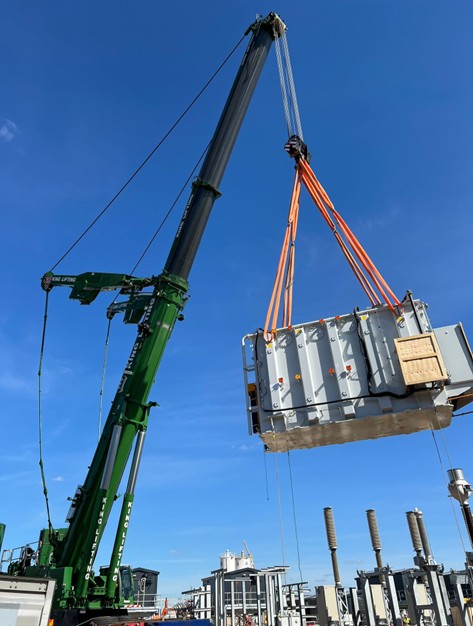
One of the most common questions we’re asked at King Lifting is, “How heavy can a crane lift?”
The answer isn’t as straightforward as you might think. While some cranes in our fleet are designed to work in confined spaces with lighter loads, others are capable of lifting up to 800 tonnes on some of the UK’s most demanding engineering projects.
The reality is that a crane’s lifting capacity depends on far more than the machine itself. In this blog, we’ll explain what affects lifting capacity and how King Lifting selects the right crane for every project.
There isn’t a single lifting capacity
Every crane has a maximum lifting capacity, but that figure only tells part of the story.
At King Lifting, our fleet ranges from mini cranes to some of the large all-terrain cranes. For example, the Maeda MC405 is a powerful mini crane capable of lifting up to 3.83 tonnes, while the Liebherr LTM1750-9.1 offers a maximum lifting capacity of 800 tonnes for complex heavy lifting projects.
Between these are dozens of other cranes, each designed for different lifting requirements, allowing us to match the right equipment to every project.
What affects how much a crane can lift?
Several factors influence the safe lifting capacity of a crane.
The weight of the load
Before any lifting operation begins, it’s essential to know exactly what’s being lifted. Whatever the project knowing weight of the load helps determine which crane is most suitable for the job.
The lifting radius
The further a load is from the centre of the crane, the lower the crane’s lifting capacity becomes. A crane lifting close to its position can safely handle a much heavier load than when working at a greater distance. This is one of the most important factors considered during lift planning.
The lifting height
Projects requiring loads to be positioned at height may require different crane configurations. For example, lifting equipment onto the roof of an existing building requires a different approach to placing heavy components at ground level, even if the loads weigh the same.
Ground conditions
Ground conditions must be carefully assessed before a crane is positioned, ensuring the equipment can operate safely throughout the lifting operation. Where required, additional support such as outrigger mats or specialist ground protection may be incorporated into the lift plan.
The crane configuration
Many cranes can be configured to suit different lifting requirements. Factors such as boom length, counterweights and luffing jibs all influence lifting performance, allowing the crane to be adapted for the specific demands of each project.
Choosing the right crane
Selecting the right crane isn’t about choosing the largest machine; it’s about choosing the most appropriate one.
For example:
The Terex-Demag AC40 City Crane is well suited to projects with restricted access, thanks to its compact footprint and manoeuvrability.
The Liebherr LTM1230-5.1 is regularly used on construction projects where greater lifting capacity and reach are required.
For more demanding heavy lifting operations, the Liebherr LTM1650-8.1 provides an impressive lifting capacity of up to 700 tonnes, supporting some of the UK’s larger engineering and construction projects.
By operating one of the UK’s largest mobile crane fleets, King Lifting can select equipment that’s tailored to the specific requirements of each lift rather than relying on a one-size-fits-all solution.
So, how heavy can a crane lift?
Well it depends! The answer requires will varying depending on the crane, the way it’s configured and the environment it’s working in.
Explore our Fleet to discover the range of cranes available, or get in touch to discuss the right lifting solution for your next project.