


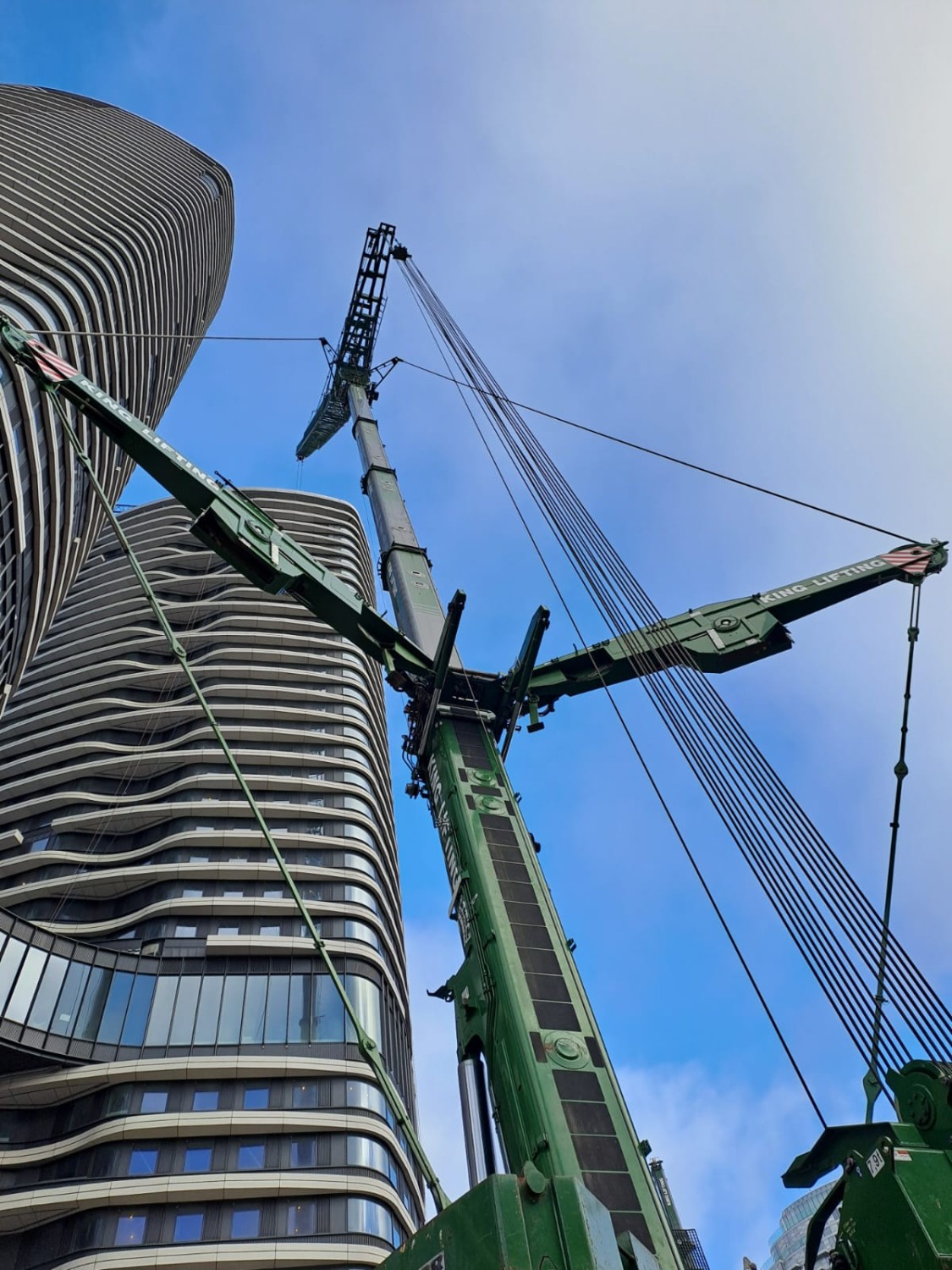
Working in the heart of a city comes with its own set of challenges, but when those challenges are elevated to 113 metres above road level, precision and planning are slightly more tricky. Recently, we were tasked with dismantling a Jost JTL 168.8 luffing jib tower crane positioned on a steel grillage adjacent to Canary Wharf, London.
This was a complex operation in a constrained urban environment, requiring careful coordination, specialised equipment, and a methodical approach at every stage.
Planning every move
For projects of this scale, success starts long before any crane arrives on site. The first step is understanding the environment. In this case, surrounding high-rises, limited ground space, and proximity to transport routes left very little room for error.
Using detailed CAD modelling, we analysed multiple crane positions to determine the optimal setup. We needed to make use of every meter of space, not just for reach, but for stability, clearance, and safe movement of the luffing jib components. Planning extended beyond this as well to the levelling strategy, sequencing of lifts and more to ensure the operation could be delivered safely and efficiently.
Equipment selection and setup
The primary crane for this project was an LTM 1650‑8.1, paired with an 80.5-metre luffing jib and 125-tonne counterweight. Supporting operations were carried out using an LTM 1090‑4.2 with a 22.5-tonne counterweight.
Setting up these cranes in a tight space required bespoke engineering solutions. Outrigger mats were designed to account for a challenging site gradient, while hybrid ground-build and aerial connection methods were used to assemble the luffing jib safely within the limited footprint.
Overcoming urban constraints
Working in a dense urban environment presents challenges that go beyond weight and reach. Each movement had to account for neighbouring buildings, overhead lines, and street-level traffic. The Y‑Guy system was carefully managed to avoid any interference with nearby structures, while lift sequences were choreographed to maintain safety at every stage.
Even with extensive planning, flexibility remained key. Weather, shifting site conditions, and unforeseen constraints required the team to adapt in real time.
High-altitude monitoring
MEWP access was used for finishing connections close to ground level, while all aerial operations were monitored and coordinated to the highest standards of safety and efficiency.
The result was a complex, high-altitude dismantle delivered on schedule, with careful attention to detail at every stage and a successful lift.
“A key factor in the success of this project was the close collaboration between all teams involved, from engineering and planning through to on-site execution. Clear communication and precise coordination ensured that each phase of the rigging, dismantling and derigging process was carried out safely and efficiently, particularly when working at height and within such a restricted footprint. By aligning technical expertise with real-time decision-making on site, the team was able to maintain control over a highly complex operation, minimising risk while keeping the programme on track.
This was a tremendous team effort, and I would like to extend thanks to everyone involved for their professionalism, commitment, and contribution to delivering the project successfully.” Adam Catchpole, Heavy Cranes Sales & Contracts Manager.