


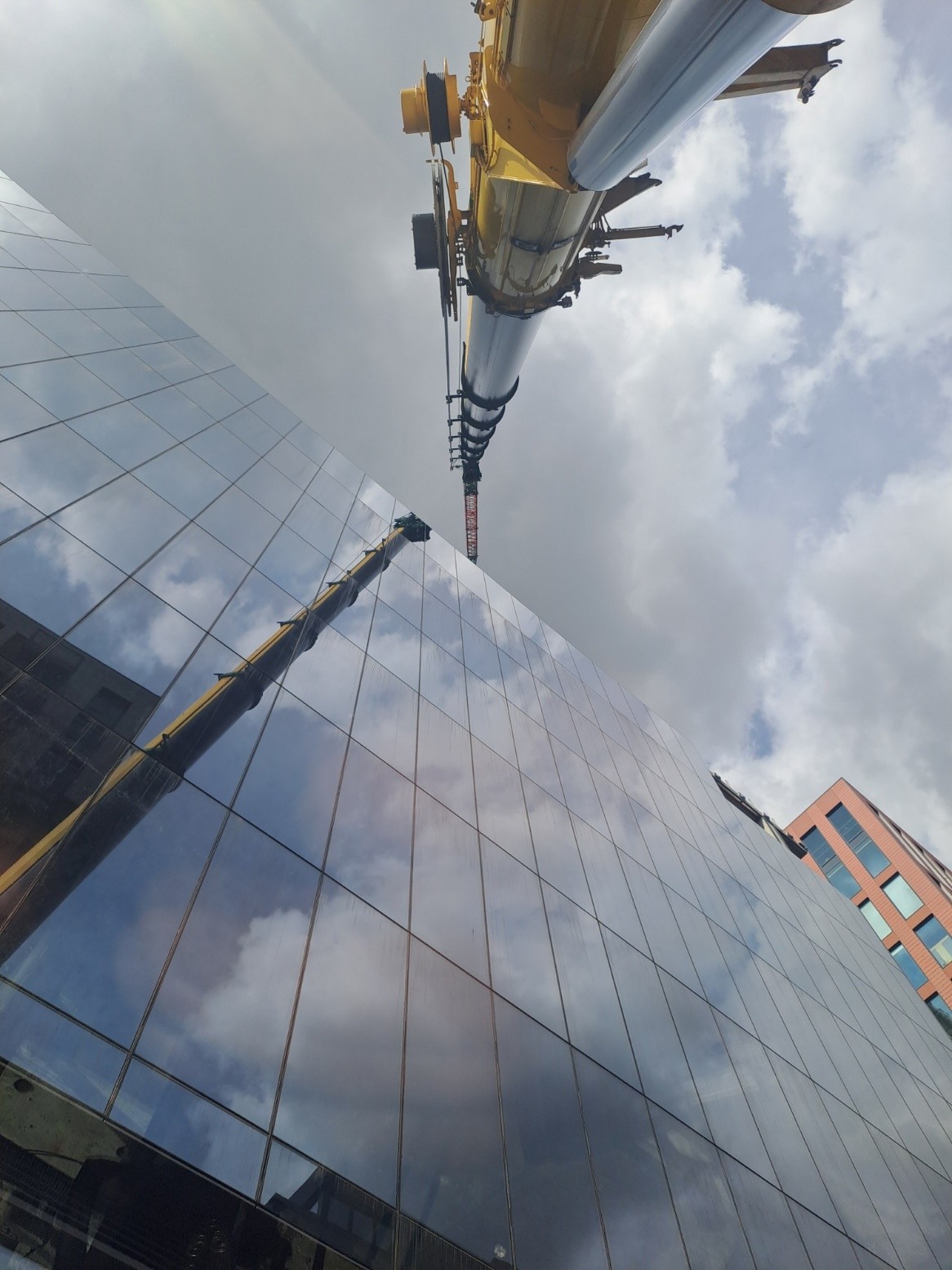
Some lifts are straightforward. Others leave no room for error.
We regularly work in environments where space is limited and access is tight. That could be inside a data centre, within a congested plant room, or on a live site where other trades are working alongside us.
You can see this across a wide range of projects. On the FR8.3 job in Germany, two large cranes had to operate within a restricted footprint, working side by side without clashing. In Madrid and Paris, our teams installed generators, switchgear and fan wall units inside live data centres, where space was tight and accuracy was critical. Similar challenges come up across projects in the Netherlands, where work often needs to be carefully sequenced around other activity on site.
The same applies across other sectors too. Lifting a tunnel boring machine from 35 metres below ground in London meant working in a confined space with very little room to maneuver. At Southampton Docks, the airbridge installation required careful positioning within an already built-up environment. The Midland Metro Alliance and Commonwealth Games projects, lifts had to be carried out in busy, restricted areas with tight deadlines.
Different jobs, but the same core challenge; limited space and no margin for error.
That’s why preparation is the most important step in our lifting projects.
Using tools like AutoCAD, we map out crane positions, lift paths and clearances in advance. It allows us to work through the lift step by step, making sure everything fits and highlighting any issues early on.
From there, it’s about choosing the right approach for the space. That might mean using multiple cranes, breaking the lift into stages, or adjusting how equipment is built and installed. On some jobs, it’s a mix of assembling at ground level and lifting into place, whatever makes the job safer and more controlled.
On site, the focus is simple: set up properly, follow the plan, and keep communication clear. When space is tight, there’s no room for guesswork.
Across all of these projects, the thinking stayed the same; understand the space, plan it properly, and carry out the lift safely.